Raphael grew up in Urbino, where his father Giovanni Santi worked as a court painter. By 1500 he was an independent master. Florence then put him in direct conversation with the work of Leonardo and Michelangelo, but his own gift was already distinct: clear human relationships held inside exact, spacious designs.
Rome transformed the scale of that work. Called by Pope Julius II in 1508, Raphael painted the papal rooms, directed a growing workshop and, after Bramante died, became architect of St Peter's. His surviving letter on ancient Rome reveals the same mind at work beyond painting: measuring, comparing, recording and arguing that ruins should be protected rather than consumed as building material.
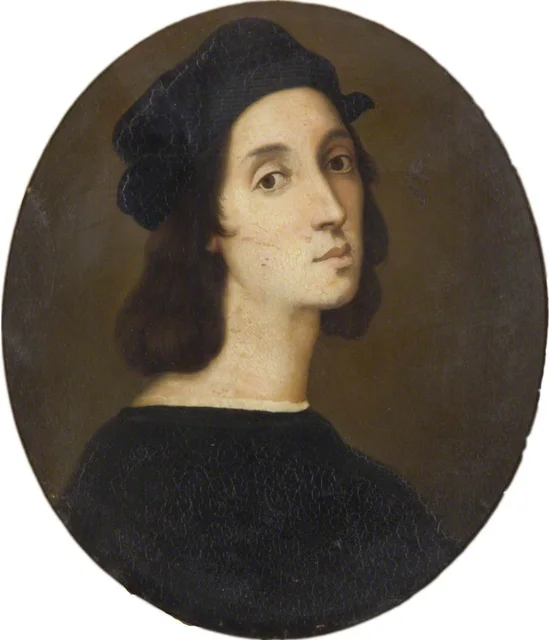
A life in dates
Born in Urbino
The National Gallery gives 6 April 1483 in Urbino; some historical literature gives 28 March, so use the exact day with a date-disputed note if needed.
National Gallery, LondonIndependent master
By 1500 Raphael was working as an independent master in central Italy.
National Gallery, LondonMoves to Florence
Raphael relocated to Florence around 1504 and studied the work of Leonardo and Michelangelo.
National Gallery, LondonCalled to Rome
Pope Julius II called Raphael to Rome to work on the papal apartments.
National Gallery, LondonRoom of the Segnatura
Raphael’s first Vatican room, including the School of Athens, was painted between 1508 and 1511.
Vatican MuseumsArchitect of St Peter’s
After Bramante’s death, Raphael was appointed architect in charge of St Peter’s.
National Gallery, LondonSurvey and Letter to Leo X
Working with Castiglione, Raphael wrote to Leo X about recording and protecting the ancient buildings of Rome.
National Gallery, LondonDies in Rome
Raphael died in Rome on Good Friday, 6 April 1520, aged 37, and was buried in the Pantheon.
National Gallery, London