Virgin of the Rocks
National Gallery Version
by Leonardo da Vinci (with assistants)
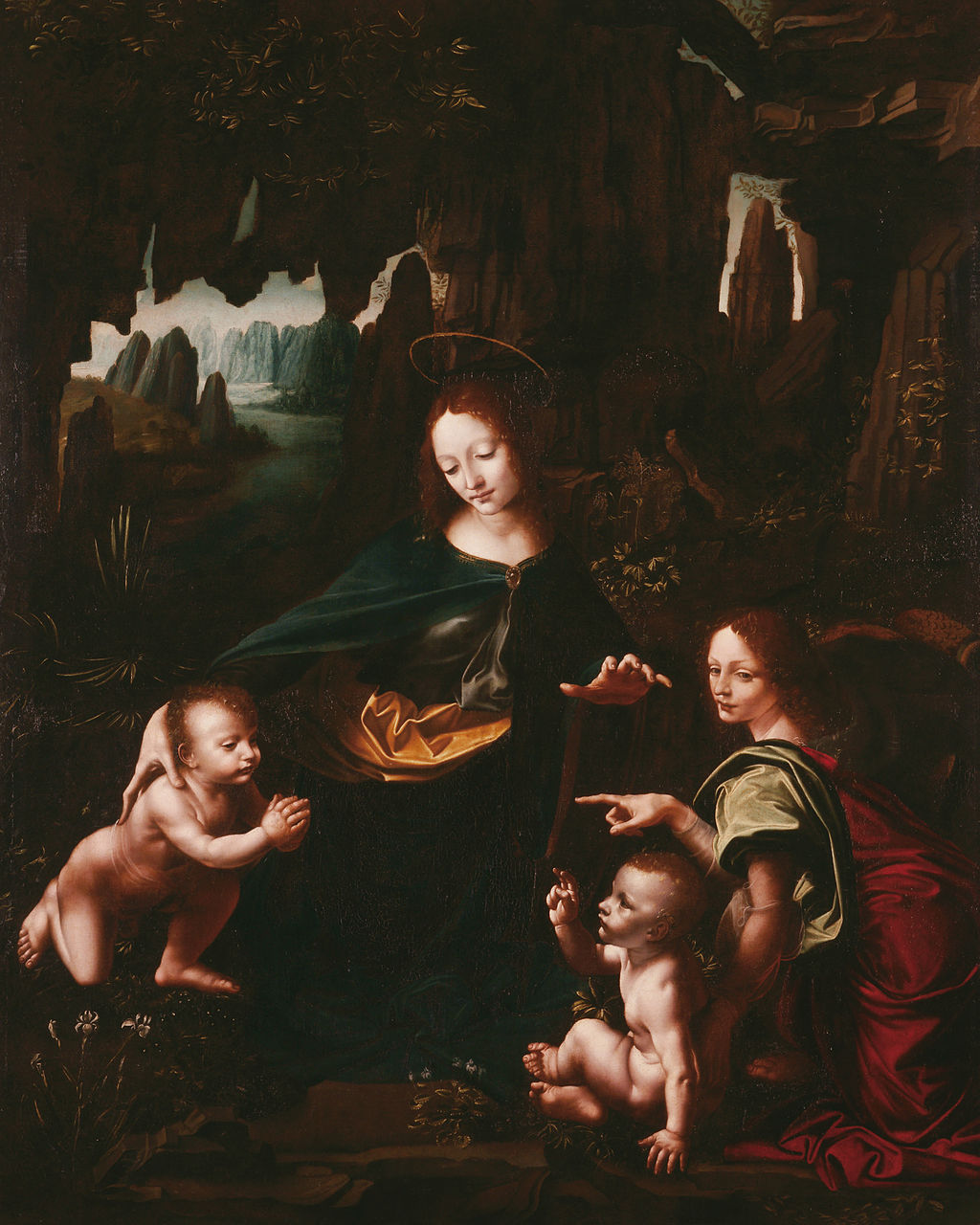
Virgin of the Rocks (London version) - National Gallery, London
Attribution Transformed By Cleaning
The 2008–2010 cleaning by Larry Keith was transformative. Previously considered largely a workshop production, the revealed quality prompted the National Gallery to declare it "largely, possibly entirely, by Leonardo, and unfinished in parts." Martin Kemp identified Leonardo's characteristic handprint blending method, particularly in the angel's head. Three painting phases were identified: (1) early 1490s start; (2) changes to Christ's head orientation; (3) 1506–08 finishing layer with ultramarine sky.
Hidden Compositions Beneath The Surface
In 2004–2005, infrared reflectography revealed two separate underdrawings — both by Leonardo. The first, an entirely abandoned composition showing a kneeling figure in an Adoration scene, was published by Syson and Billinge in the Burlington Magazine (2005). In 2019, macro X-ray fluorescence scanning revealed further details: an angel with slightly open wings looking down at the Infant Christ in a tight embrace, made with zinc-containing drawing materials.
Key differences from the Louvre version: the angel's pointing gesture is withdrawn; haloes and John's cruciform staff are present; robes shift from red/green to yellow/blue; plants become fanciful inventions rather than botanically accurate specimens. Luke Syson interprets the second version as Leonardo's evolved concept: "the painter as mirror of nature becoming the painter whose creativity is akin to the creativity of God."
Research & Analysis
The 2008–2010 cleaning by Larry Keith was transformative. Previously considered largely a workshop production, the revealed quality prompted the National Gallery to declare it "largely, possibly entirely, by Leonardo, and unfinished in parts." Martin Kemp identified Leonardo's characteristic handprint blending method, particularly in the angel's head. Three painting phases were identified: (1) early 1490s start; (2) changes to Christ's head orientation; (3) 1506–08 finishing layer with ultramarine sky.
In 2004–2005, infrared reflectography revealed two separate underdrawings — both by Leonardo. The first, an entirely abandoned composition showing a kneeling figure in an Adoration scene, was published by Syson and Billinge in the Burlington Magazine (2005). In 2019, macro X-ray fluorescence scanning revealed further details: an angel with slightly open wings looking down at the Infant Christ in a tight embrace, made with zinc-containing drawing materials.