St. John the Baptist
by Leonardo da Vinci
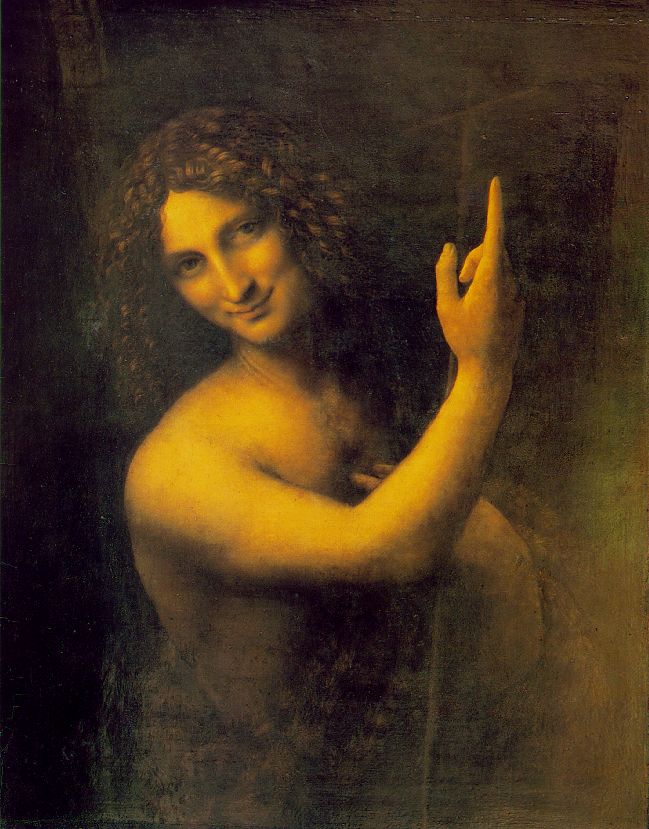
Saint John the Baptist - Musee du Louvre, Paris
The 2015–2016 Restoration
The painting hadn't been cleaned since 1802 — over 200 years. C2RMF found 15–17 layers of oxidized varnish with total thickness of approximately 110 μm. Approximately half was thinned during restoration, revealing the figure's structural relief, sinuous twisting movement, and subtle facial expression for the first time in centuries. Three micro-samples were analyzed by optical microscopy, SEM-EDX, FTIR, and GC-MS.
The Androgyny Question
The figure is "suavely beautiful, youthful and slightly androgynous" — at variance with traditional depictions of the Baptist as a gaunt ascetic. Kenneth Clark called Saint John "the eternal question mark, the enigma of creation." Paul Barolsky noted "a disturbingly erotic charge" that "nonetheless conveys a spiritual meaning." The model was almost certainly Salaì (Gian Giacomo Caprotti da Oreno), Leonardo's longtime companion. The same model appears in the Bacchus and the Angelo incarnato drawing. Cassiano dal Pozzo, seeing it at Fontainebleau in 1625, remarked it had "neither devotion, decorum nor similitude."
Advanced Sfumato Analysis
The C2RMF/Louvre scientific studies (published in Techné, 2024) describe this as "a nearly monochrome masterpiece which sublimates the sfumato technique" with "remarkable economy of means." In his late works, Leonardo simultaneously reduced the base white-pink layer in shadow areas AND built up darker glazes — a dual tapering technique creating sublimely smooth transitions. The complete absence of visible brushwork confirms Leonardo used his fingertips, soft cloths, and possibly feathers rather than brushes for final blending. Scientists confirm the application is consistent with finger manipulation rather than brush — producing the ethereal "airbrush-like" quality.
Research & Analysis
The Pointing Gesture As Leonardo'S Signature Motif: The upward-pointing index finger recurs across Leonardo's career: angel in the Louvre Virgin of the Rocks, Saint Anne in the Burlington House Cartoon, the Bacchus, and this final Saint John. It signifies divine communication, the path to salvation, and heavenly transcendence. The cross and wool skins may have been added by a later hand.