Salvator Mundi
Saviour of the World
attributed to Leonardo da Vinci
âš ï¸ Contested Attribution / Heavily Restored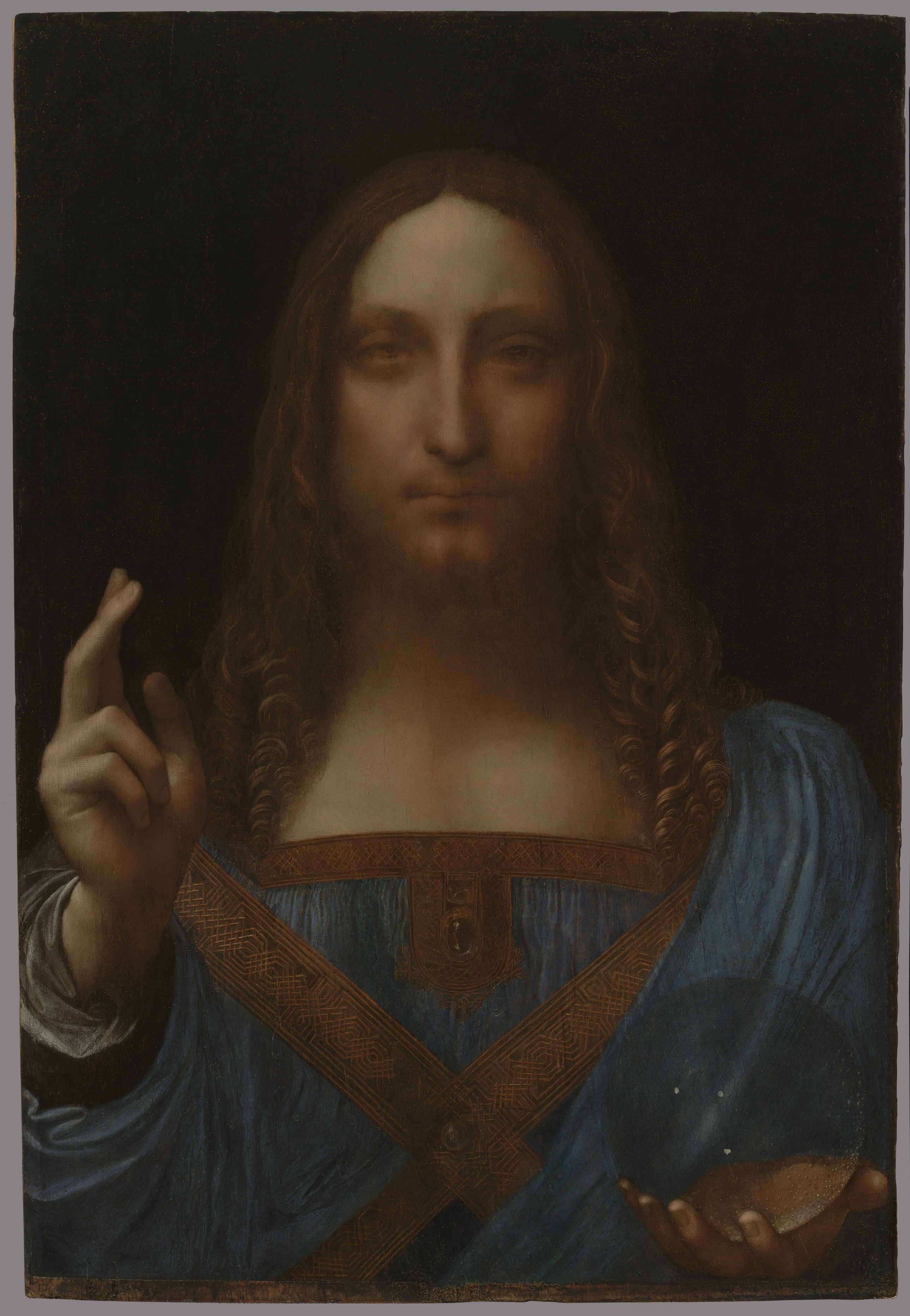
Salvator Mundi (Savior of the World)
From $1,175 To $450 Million — The Most Dramatic Rediscovery In Art History
In April 2005, the painting was purchased at a New Orleans estate sale (Lot 664: "After Leonardo da Vinci: Christ Salvator Mundi") by Alexander Parish and Robert Simon for $1,175. It was heavily overpainted, "a wreck, dark and gloomy," the face "grotesquely repainted" (later described by Martin Kemp as resembling "a drug-crazed hippy"). Conservator Dianne Dwyer Modestini (NYU) spent six years restoring it (2005–2011). In 2008, it was taken to the National Gallery London for comparison with the Virgin of the Rocks, viewed by five Leonardo experts. By 2011, attribution to Leonardo was announced.
The sales chain: sold c. 2013 to dealer Yves Bouvier for ~$83 million → immediately resold to Russian oligarch Dmitry Rybolovlev for $127.5 million → sold at Christie's on November 15, 2017 for $450,312,500 (most expensive painting ever sold at auction). Buyer: Prince Badr bin Abdullah, reportedly acting as proxy for Crown Prince Mohammed bin Salman. The painting was reportedly kept on MBS's 439-foot superyacht Serene until 2020.
The Great Attribution Divide
Supporters (Luke Syson, Martin Kemp, Robert Simon, Dianne Modestini, Louvre C2RMF team): cite the pentimento in the blessing hand's thumb (a copyist would reproduce exactly), sfumato technique consistent with Leonardo's late works, Windsor Castle drapery studies universally accepted as Leonardo's, the crystal orb's subtle optical properties, and materials analysis.
Skeptics marshal powerful counterarguments. Carmen Bambach (Met curator) attributes most of the painting to Boltraffio, with "only small retouchings by the master." Frank Zöllner (Leipzig) did not include it among Leonardo's autograph paintings, calling it "either a follower's work or a high-quality workshop product." His devastating 2021 assessment: "The old parts of the painting which are original — these are by pupils — and the new parts which look like Leonardo, but they are by the restorer. In some part, it's a masterpiece by Dianne Modestini." Matthew Landrus (Oxford) attributes it to Bernardino Luini. Jacques Franck attributes it to Salaì and Boltraffio jointly. Even Vincent Delieuvin (Louvre curator, initially supportive) noted "details of surprisingly poor quality" by 2021. The Prado catalogued it as "workshop of, authorized and supervised by Leonardo."
The Crystal Orb Mystery
Christ holds a transparent crystal orb that does not refract light as a solid sphere should — puzzling given Leonardo's mastery of optics. UC Irvine computer scientists demonstrated in 2019–2020 that a hollow glass sphere with walls ~1.3 mm thick, positioned 25 cm in front of the figure, would produce exactly the appearance Leonardo painted — making the painting optically accurate rather than anomalous. Martin Kemp argues the subtle inclusions show Leonardo's knowledge of rock crystal. The orb mystery is central to both authentication and interpretation.
Research & Analysis
In April 2005, the painting was purchased at a New Orleans estate sale (Lot 664: "After Leonardo da Vinci: Christ Salvator Mundi") by Alexander Parish and Robert Simon for $1,175. It was heavily overpainted, "a wreck, dark and gloomy," the face "grotesquely repainted" (later described by Martin Kemp as resembling "a drug-crazed hippy"). Conservator Dianne Dwyer Modestini (NYU) spent six years restoring it (2005–2011). In 2008, it was taken to the National Gallery London for comparison with the Virgin of the Rocks, viewed by five Leonardo experts. By 2011, attribution to Leonardo was announced.
Supporters (Luke Syson, Martin Kemp, Robert Simon, Dianne Modestini, Louvre C2RMF team): cite the pentimento in the blessing hand's thumb (a copyist would reproduce exactly), sfumato technique consistent with Leonardo's late works, Windsor Castle drapery studies universally accepted as Leonardo's, the crystal orb's subtle optical properties, and materials analysis.