Saint Jerome in the Wilderness
by Leonardo da Vinci
âš ï¸ Unfinished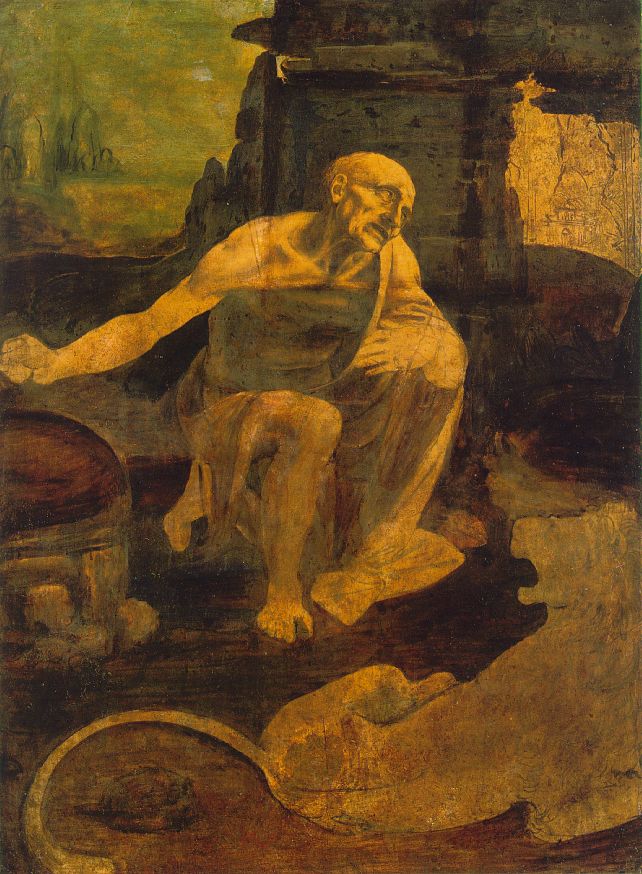
Saint Jerome in the Wilderness - Vatican Museums, Rome
The Discovery Story — Revised
The popular legend claims Cardinal Joseph Fesch found the torso as a table-top in a junk shop and later found the head as a shoemaker's wedge. However, Jan Sammer's 2023 research (Raccolta Vinciana, vol. 40) reveals the panel was deliberately dismembered by Roman art dealer Pietro Camuccini with four straight incisions to extract the more finished head for separate sale. The head was sold to Cardinal Fesch in 1819; Fesch later found the headless panel at the Corrazzetto antiques shop on Piazza Navona and reunited the pieces. The panel was cut into five pieces total; infrared reflectography still shows the incision lines. Pope Pius IX acquired it in 1856.
Attribution And Dating
Despite being unfinished, attribution to Leonardo has never been questioned (Vatican Museums statement). The extraordinary anatomical accuracy of the sternocleidomastoid muscles, tendons, and sparse musculature represents Leonardo's dissection knowledge. Leonardo's fingerprints were documented in the upper left sky in 2019 and 2023 by Vatican diagnostic labs. The dating controversy persists: most scholars (Kemp, Marani, Zöllner) favor c. 1480–1482 based on stylistic similarities with the Adoration of the Magi, while Luke Syson argues for c. 1488–1490 based on the walnut panel.
Subject And Context
Jerome is depicted as a haggard penitent kneeling in a rocky landscape, right hand holding a rock for self-flagellation, gazing toward a barely sketched crucifix at the extreme right. A lion lounges at his feet in an S-curve. Leonardo may have identified with Jerome's suffering — the 1476 sodomy accusation, though resulting in acquittal, appears to have left psychological scars. His contemporaneous diary entries read: "I thought I was learning to live; I was only learning to die."
The unfinished state is enormously valuable for understanding Leonardo's working process: visible primed ochre ground, monochrome compositional draft, layered glazes for chiaroscuro, and finger-blending for sfumato.
Research & Analysis
The popular legend claims Cardinal Joseph Fesch found the torso as a table-top in a junk shop and later found the head as a shoemaker's wedge. However, Jan Sammer's 2023 research (Raccolta Vinciana, vol. 40) reveals the panel was deliberately dismembered by Roman art dealer Pietro Camuccini with four straight incisions to extract the more finished head for separate sale. The head was sold to Cardinal Fesch in 1819; Fesch later found the headless panel at the Corrazzetto antiques shop on Piazza Navona and reunited the pieces. The panel was cut into five pieces total; infrared reflectography still shows the incision lines. Pope Pius IX acquired it in 1856.
Despite being unfinished, attribution to Leonardo has never been questioned (Vatican Museums statement). The extraordinary anatomical accuracy of the sternocleidomastoid muscles, tendons, and sparse musculature represents Leonardo's dissection knowledge. Leonardo's fingerprints were documented in the upper left sky in 2019 and 2023 by Vatican diagnostic labs. The dating controversy persists: most scholars (Kemp, Marani, Zöllner) favor c. 1480–1482 based on stylistic similarities with the Adoration of the Magi, while Luke Syson argues for c. 1488–1490 based on the walnut panel.