Mona Lisa (Louvre)
by Leonardo da Vinci
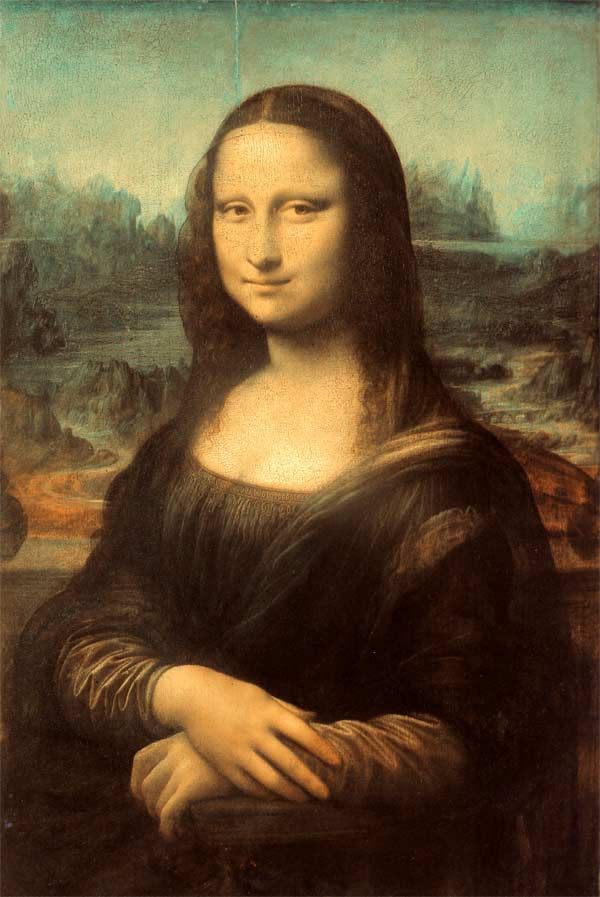
Mona Lisa (La Gioconda) — Musée du Louvre, Paris
The 1911 Theft
Vincenzo Peruggia, an Italian handyman who had helped construct the Mona Lisa's protective glass case, hid in a storage closet overnight on August 21, 1911 (the museum's closing day). He emerged at 7:15 AM, lifted the painting off the wall, removed the glass shadow box in an adjacent stairwell, and walked out with it under his smock. A plumber unlocked a stuck service door for him. The theft wasn't discovered for 28 hours. Guillaume Apollinaire was arrested and implicated Pablo Picasso — both were released. Peruggia's thumbprint was on the glass and in police files, but investigators never cross-referenced. After two years hiding the painting in his apartment, Peruggia contacted Florentine art dealer Alfredo Geri under the alias "Leonardo Vincenzo." He was arrested in Florence and served only seven months.
Pascal Cotte'S Multispectral Revelations
French engineer Pascal Cotte spent 15+ years analyzing 1,650+ images captured with an ultra-high-resolution multispectral camera. His Layer Amplification Method processes up to 3.2 billion data points. Key discoveries: Spolvero underdrawing (published 2020, Journal of Cultural Heritage): First detection of charcoal pouncing transfer technique, proving a preparatory cartoon was used — meaning a Leonardo drawing of the Mona Lisa may still exist Evidence of up to four superimposed portraits: an entirely different woman beneath the current surface, with larger head, larger nose, smaller lips, and different gaze direction A hidden pearl headdress in the underdrawing, later removed The original Mona Lisa apparently didn't smile Eyebrows and eyelashes were originally painted (consistent with Vasari), gradually disappearing from overcleaning
The Smile As Optical Illusion
Harvard neuroscientist Margaret Livingstone (2003) demonstrated the smile's enigmatic quality exploits the difference between foveal and peripheral vision. When you look directly at the mouth, the smile fades; look at the eyes, and it returns. Peripheral vision detects shadows around the cheeks that expand the smile when perceived indirectly. Leonardo's sfumato exploits this neurological reality — centuries before the science was understood.
Research & Analysis
The Sfumato Mystery Decoded: Philippe Walter's C2RMF team used X-ray fluorescence spectroscopy to map the paint structure: priming layer of lead white → flesh-tone paint → sfumato shadowing glaze → varnish. In darker areas, manganese-containing glaze is applied more thickly. "Neither brushstroke nor contour is visible: lights and shades are blended in the manner of smoke" — achieving what scientists describe as an "airbrush-like" effect centuries before airbrushes existed. Each glaze layer required weeks to months of drying time, explaining why Leonardo worked on the painting for 4–16 years.
Identity And Provenance: The 2005 discovery of a marginal note by Agostino Vespucci in a 1477 Cicero printing confirmed Leonardo was painting Lisa Gherardini, wife of Francesco del Giocondo, in October 1503. Francis I purchased it for 4,000 écus in approximately 1518. It passed through the Royal Collection to the Louvre, with a brief sojourn in Napoleon's bedroom at the Tuileries.