Madonna of the Carnation
by Leonardo da Vinci
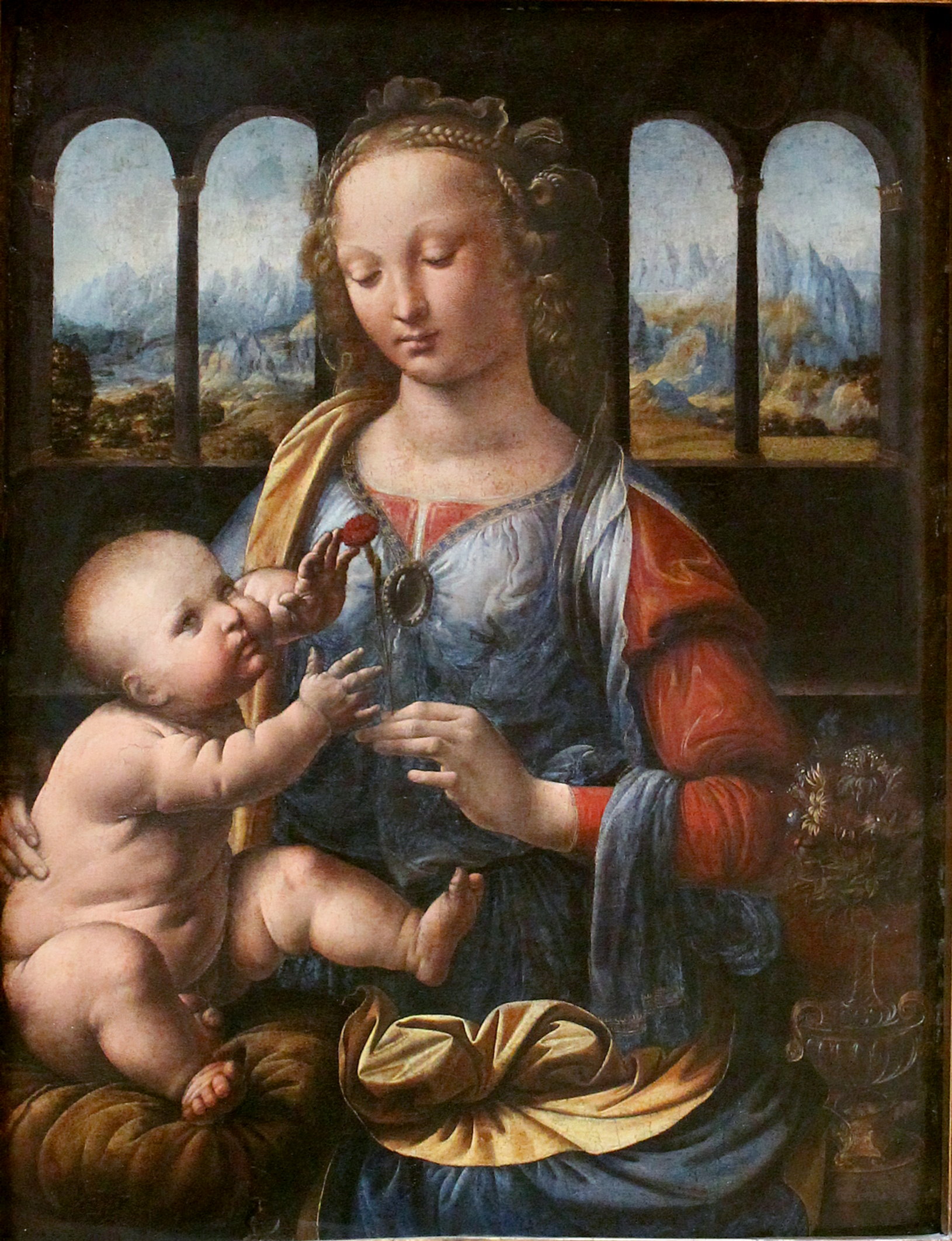
Madonna of the Carnation - Alte Pinakothek, Munich
Attribution Analysis
Originally attributed to Verrocchio. The shift to Leonardo occurred gradually in the 19th century, supported by the handling of drapery, the near-scientific rendering of carnations, compositional similarities to the Benois Madonna, and mountain scenery with atmospheric perspective that departs from Verrocchio's style. A Flemish overpainting was identified by scholars — an unknown artist "probably Flemish" completed overpainting before the 1889 acquisition. An improper restoration gave the surface a characteristic "leathery" appearance, especially on the Madonna's face.
Mysteries
Japanese research proposes that the carnation resulted from a compositional modification: the original flower was positioned differently, and Leonardo added a brooch at the chest, necessitating the flower's repositioning and selection of a long-stemmed carnation. The painting's deteriorated condition has meant it receives less scholarly attention than other Leonardo works.
Research & Analysis
Originally attributed to Verrocchio. The shift to Leonardo occurred gradually in the 19th century, supported by the handling of drapery, the near-scientific rendering of carnations, compositional similarities to the Benois Madonna, and mountain scenery with atmospheric perspective that departs from Verrocchio's style. A Flemish overpainting was identified by scholars — an unknown artist "probably Flemish" completed overpainting before the 1889 acquisition. An improper restoration gave the surface a characteristic "leathery" appearance, especially on the Madonna's face.
Japanese research proposes that the carnation resulted from a compositional modification: the original flower was positioned differently, and Leonardo added a brooch at the chest, necessitating the flower's repositioning and selection of a long-stemmed carnation. The painting's deteriorated condition has meant it receives less scholarly attention than other Leonardo works.