La Belle Ferronnière
by Leonardo da Vinci
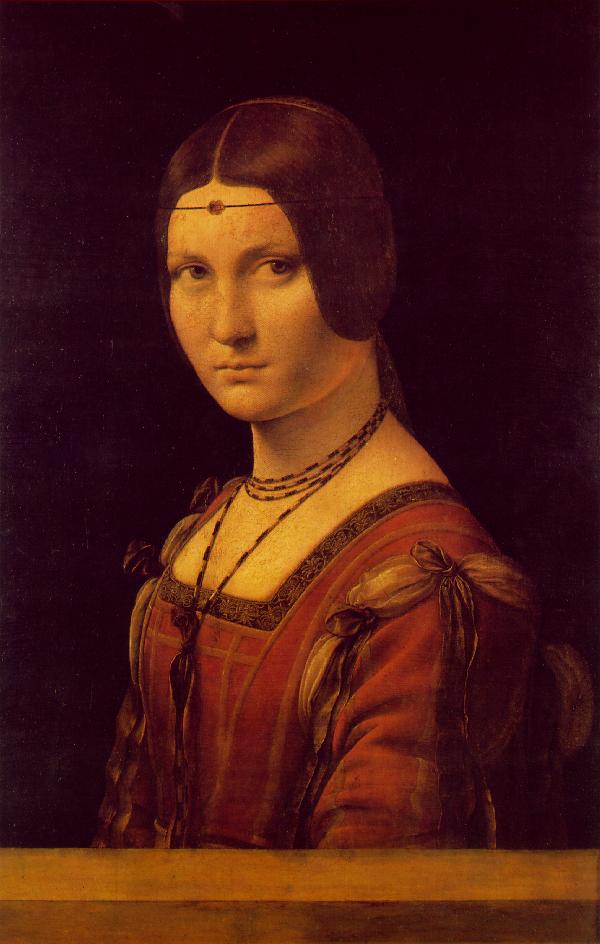
La Belle Ferronniere - Musee du Louvre, Paris
Attribution And The Hahn Court Case
The attribution has been challenged: Bernard Berenson ascribed it to Bernardino de' Conti, while Herbert Cook initially proposed Boltraffio before reverting to Leonardo. Modern infrared reflectography revealed pentimenti (alterations to facial contours and ferronnière position) characteristic of Leonardo's iterative process.
The painting became the subject of "the world's most celebrated case of art litigation" when Andrée Hahn claimed her canvas version was the genuine Leonardo. Sir Joseph Duveen declared it a copy without seeing it. The 1929 New York trial was inconclusive — the jury couldn't agree — and Duveen settled for $60,000. The Hahn version sold at Sotheby's in 2010 for $1,538,500 as "by a follower of Leonardo."
Subject
The sitter's identity remains debated: Lucrezia Crivelli (traditional identification, Ludovico's later mistress), Beatrice d'Este (proposed at the 2011 National Gallery exhibition), or Isabella of Aragon. The "ferronnière" headband is actually a common Lombard fashion accessory called a lenza. XRF analysis by C2RMF reveals that unlike the Mona Lisa, Leonardo did not use translucent glazes for shadow effects here — he used opaque dark pigments, placing this work earlier in his sfumato development.
Research & Analysis
The attribution has been challenged: Bernard Berenson ascribed it to Bernardino de' Conti, while Herbert Cook initially proposed Boltraffio before reverting to Leonardo. Modern infrared reflectography revealed pentimenti (alterations to facial contours and ferronnière position) characteristic of Leonardo's iterative process.
The sitter's identity remains debated: Lucrezia Crivelli (traditional identification, Ludovico's later mistress), Beatrice d'Este (proposed at the 2011 National Gallery exhibition), or Isabella of Aragon. The "ferronnière" headband is actually a common Lombard fashion accessory called a lenza. XRF analysis by C2RMF reveals that unlike the Mona Lisa, Leonardo did not use translucent glazes for shadow effects here — he used opaque dark pigments, placing this work earlier in his sfumato development.