Benois Madonna
Madonna and Child with Flowers
by Leonardo da Vinci
📋 Attribution Debated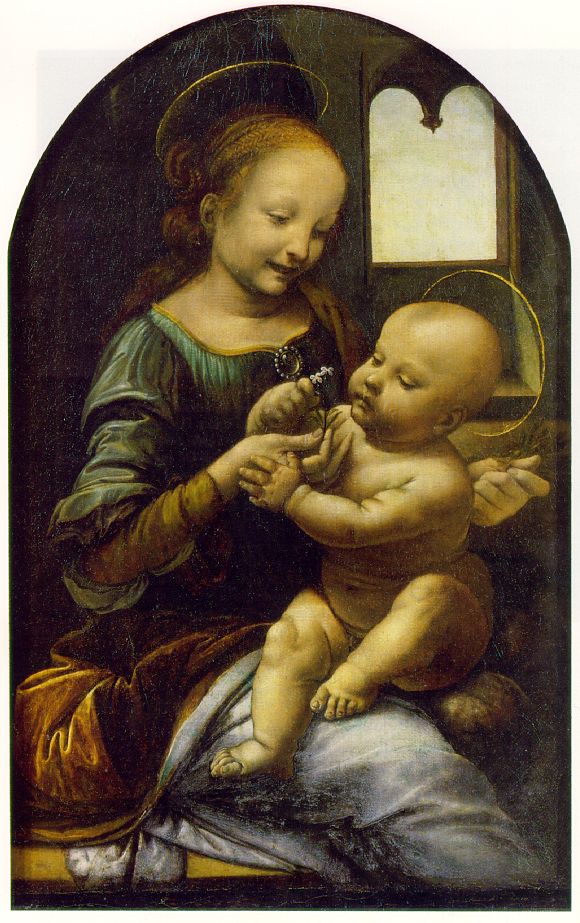
Benois Madonna - Hermitage Museum, St Petersburg
Attribution And Condition
The vast majority of scholars accept the Benois Madonna as authentic Leonardo. Two preliminary sketches in the British Museum (identified by Popham and Pouncey, 1950) relate directly to the composition. However, Bernard Berenson famously disparaged it: "The hands are wretched, the folds purposeless and fussy, the color like whey. And yet I had to acknowledge that this painful affair was the work of Leonardo da Vinci." The painting has suffered significant damage from the 19th-century transfer and probable overpainting by later hands. Parts appear unfinished — one hand is merely sketched in, and the Madonna's "toothless smile" may indicate an incomplete mouth.
Subject And Iconography
An intimate scene of the Virgin Mary and Christ Child in a dark room with a double-arched window. Mary holds a bitter cress flower whose petals form a cross — a symbol of the coming Crucifixion that the infant hasn't yet recognized. Larry Feinberg (2011) interprets this as Leonardo exploring the relationship between "sight" and "insight." This is considered likely Leonardo's first fully independent painting and one of his most joyous depictions of Mary.
Research & Analysis
The vast majority of scholars accept the Benois Madonna as authentic Leonardo. Two preliminary sketches in the British Museum (identified by Popham and Pouncey, 1950) relate directly to the composition. However, Bernard Berenson famously disparaged it: "The hands are wretched, the folds purposeless and fussy, the color like whey. And yet I had to acknowledge that this painful affair was the work of Leonardo da Vinci." The painting has suffered significant damage from the 19th-century transfer and probable overpainting by later hands. Parts appear unfinished — one hand is merely sketched in, and the Madonna's "toothless smile" may indicate an incomplete mouth.
An intimate scene of the Virgin Mary and Christ Child in a dark room with a double-arched window. Mary holds a bitter cress flower whose petals form a cross — a symbol of the coming Crucifixion that the infant hasn't yet recognized. Larry Feinberg (2011) interprets this as Leonardo exploring the relationship between "sight" and "insight." This is considered likely Leonardo's first fully independent painting and one of his most joyous depictions of Mary.