Vitruvian Man
Le proporzioni del corpo umano secondo Vitruvio
by Leonardo da Vinci
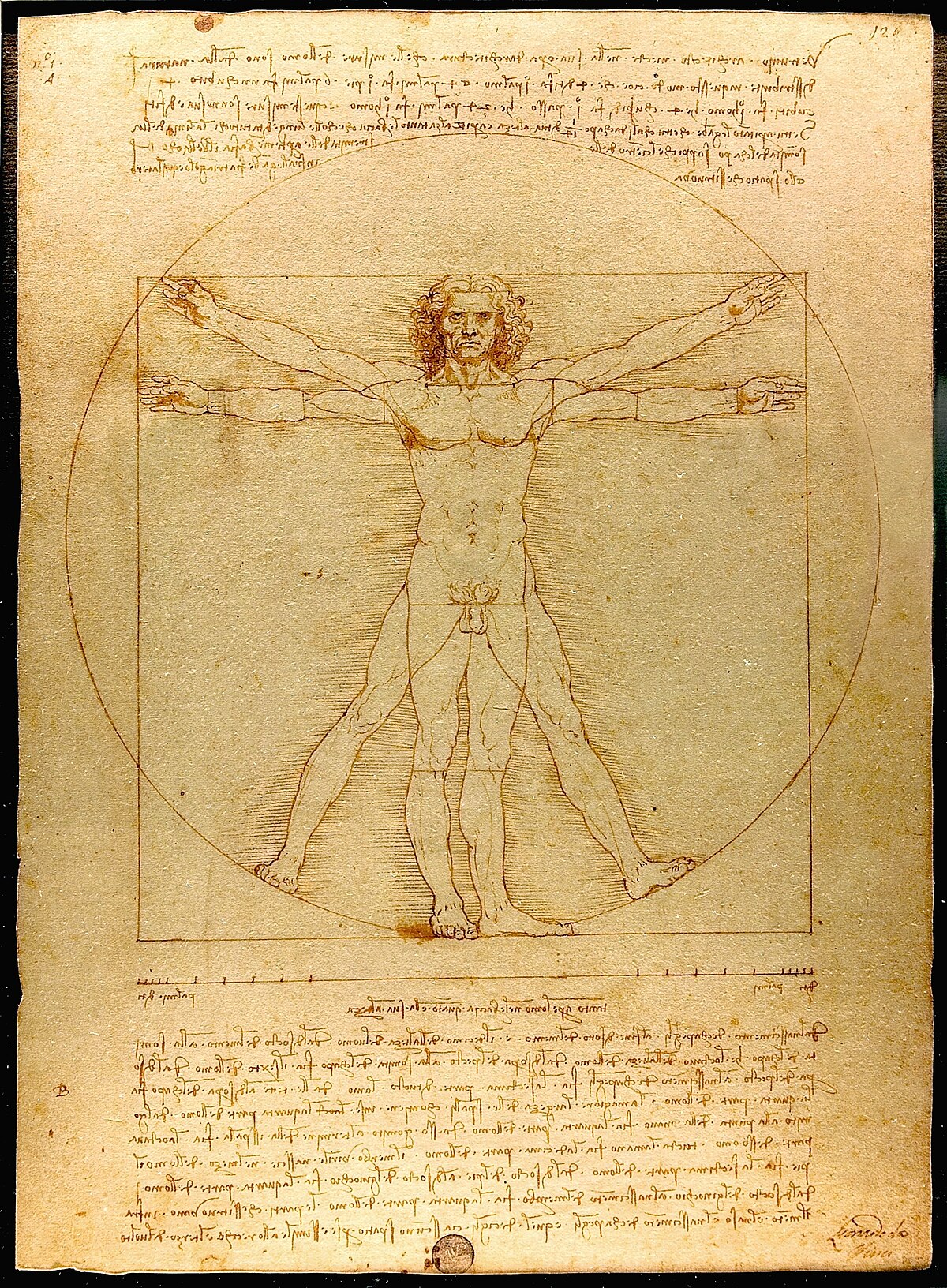
Vitruvian Man - Gallerie dell'Accademia, Venice
The Drawing That Holds Everything Together
Leonardo's Vitruvian Man is far more than an anatomical sketch — it is a geometric proof that the human body bridges the material and divine realms, resolving a puzzle that defeated every artist who attempted it before. His breakthrough: recognizing that the circle and square require different centers — the navel for the circle, the genitals for the square — and that the figure must occupy two simultaneous poses.
Empiricism Over Authority
While crediting Vitruvius, Leonardo quietly corrected him. His lower inscription contains 15 specific ratios measured from living Milanese men — changing the foot from 1/6 to 1/7 of height, adding the elbow-to-armpit ratio, introducing the equilateral triangle between spread legs. Many measurements actually retrace Alberti's De statua rather than Vitruvius's Latin. A 2020 JAMA study of 63,623 body scans validated most of Leonardo's proportions within 10%.
Where Philosophy Becomes Geometry
The drawing visualizes an entire philosophical revolution. The circle represents the divine, the infinite, spiritual perfection. The square represents the earthly, the material, the four elements. The human figure touching both demonstrates that humanity participates in both realms simultaneously — a visual synthesis of ideas from Protagoras, Plato, Pico della Mirandola, Nicholas of Cusa, and the Hermetic tradition, all encoded in one deceptively simple composition.
Explore The Vitruvian Man
Ten deep dives into the anatomy, geometry, philosophy, and legacy of the world's most famous drawing.
The Proportions
15 measured ratios, the 96-finger metrological system, and how Leonardo corrected 1,500 years of ancient authority.
Circle & Square
The geometric breakthrough — why every other artist failed, and how offset centers solved the impossible.
The Golden Ratio Myth
Why φ ≈ 1.618 is almost certainly absent — and how a 19th-century obsession hijacked the drawing.
Squaring the Circle
The ancient impossible problem, Leonardo's obsessive attempts, and the symbolic resolution the body provides.
Renaissance Humanism
From Protagoras to Pico della Mirandola — the philosophical revolution made visible in one drawing.
The Esoteric Traditions
Hermeticism, alchemy, Kabbalah — the mystical currents converging in circle, square, and human form.
Nicholas of Cusa
Coincidentia oppositorum — how the "coincidence of opposites" maps precisely onto the drawing's geometry.
Milan, 1490
Sforza's court, the tiburio competition, the Pavia trip, and the brilliant friend executed by the French.
The Physical Object
Iron gall ink on paper — 25 lux, six-year intervals, and the 2019 Louvre controversy.
Icon & Legacy
The €1 coin, Le Corbusier's Modulor, NASA patches, Dan Brown, and an Arctic ice floe.
Method as Message
What makes the Vitruvian Man genuinely revolutionary is not any single proportion or geometric relationship but the method it represents. Leonardo did not simply illustrate Vitruvius. He tested Vitruvius against reality, corrected what observation contradicted, synthesized multiple sources — Alberti, his own dissection work, measurements of living men — and produced something that exceeded them all.
The drawing is thus a prototype of the scientific method — hypothesis tested against empirical evidence, authority deferred to observation — wrapped in sacred geometry and drawn with the hand of a master artist. It is simultaneously an empirical correction of ancient authority and a tribute to that authority. A mathematical diagram and a work of art. It places man at the center of creation while acknowledging the geometric tensions that make that centrality paradoxical — the circle and square cannot share a center, just as the divine and earthly cannot fully merge, yet the human body reconciles them through the elegant act of shifting position.
As Toby Lester wrote: "It is a kind of metaphysical self-portrait in which Leonardo — as an artist, a natural philosopher, and a stand-in for all humanity — peers at himself with furrowed brow and tries to grasp the secrets of his own nature." Five centuries later, we are still looking.